
Padmashree International College
Tinkune, Kathmandu01-4112252 • 9779851208403
Padmashree International College
TECHNOLOGY & AI

IT Colleges In Nepal

Padmashree Academic Faculty
•
Jul 13, 2026
•
6 min read

BIT Colleges in Nepal: Full 2026 List and How to Choose 

Nepal has roughly 39 colleges offering a Bachelor of Information Technology, split across Tribhuvan University, Purbanchal University and around eight foreign universities. They are not interchangeable. The entrance requirements, credit hours, fee ranges and degree recognition differ enough that picking the wrong one costs you four years. This guide lays out every option honestly, then gives you a way to decide. 

The three routes to a BIT in Nepal 

There is no single "BIT." There are three separate systems, and most confusion comes from students not knowing which one they are applying to. 

Route 1 — Tribhuvan University 

TU launched its BIT through the Institute of Science and Technology in 2076 BS. It runs across around 15 constituent campuses. It is the cheapest route by a wide margin and carries the weight of the national university. 

The catch: you must sit and pass TU's centralised entrance exam, and seats are limited. Competition is real, and every year a large number of capable students miss out. 

Route 2 — Purbanchal University 

Purbanchal was the first university to bring BIT to Nepal. Kantipur City College in Putalisadak was the first college to run it. The PU BIT is a 140-credit, four-year, eight-semester programme, and around seven colleges offer it. An entrance exam applies here too, with merit-based shortlisting. 

Route 3 — Foreign-affiliated colleges 

Roughly 13 colleges in Nepal run IT degrees through foreign universities. Fees are higher. The degree is internationally recognized, which matters if you plan to work or study abroad. Most importantly for many students, entrance requirements are set by the college, not by a centralized national exam. 

Colleges in this group include ISMT (University of Sunderland, UK), The British College, Islington College, Herald College, LBEF, MIT Nepal (US degree, 120 credits), Texas College (Nilai University), National College of Management and Technical Sciences (Nilai), and Padmashree College (Nilai University, Malaysia). 

Quick comparison 


TU BIT 

PU BIT 

Foreign-affiliated 

Duration 

4 years, 8 semesters 

4 years, 8 semesters 

3–4 years 

Credit hours 

~126 

140 

120–126 

Entrance exam 

Yes, centralised 

Yes 

Set by college; several require none 

Fees 

Lowest 

Moderate 

Higher 

Degree recognition 

National 

National 

International 

Seats 

Limited, competitive 

Limited 

Generally more available 

What "best" actually means 

Nobody can honestly tell you which BIT college is objectively best, and you should be sceptical of any college that claims the title outright. What exists is a best fit for your situation. Five questions settle it: 

  1. Can you clear an entrance exam, and do you want to?

If you have strong +2 results and time to prepare, TU is excellent value. If you have already missed an entrance or you do not want your future decided by one exam, foreign-affiliated colleges are the realistic route. Some, including Padmashree, admit BIT students without an entrance exam at all. 

  1. What is your real budget?

TU is cheapest. Foreign-affiliated degrees cost more, and the honest question is whether the international recognition is worth it for your plans. If you intend to work in Nepal at a local software company, a TU degree serves you perfectly well. If you are aiming at work abroad or a master's overseas, the foreign affiliation earns its cost. 

  1. Do you want to work abroad?

This is the single biggest differentiator. A foreign-affiliated degree travels. A TU degree needs more paperwork and explanation outside Nepal. 

  1. Networking or software?

BIT leans towards networks, systems and data communication more than pure programming. If you want to be a software developer specifically, look hard at BCA and BSc CSIT too before you commit. See our guide on where to study IT in Nepal. 

  1. Does the college actually do practical work?

Ask to see the labs. Ask what the final-year project looks like. Ask whether internships are built into the curriculum or left to you. A college that cannot answer these concretely is selling you a brochure. 

Where Padmashree fits 

We are not going to tell you we are the best college in Nepal. Here is what we actually are, so you can judge for yourself. 

Padmashree College in Tinkune, Kathmandu, runs a BIT (Hons) affiliated with Nilai University, Malaysia. It is a 126-credit-hour program covering core computing, software design, networking, cloud architecture, cybersecurity, AI, and dynamic web programming, with electives in IoT, blockchain, and big data. A six-credit internship is required to graduate. The final year runs a two-part capstone project. 

The thing that genuinely separates us: there is no entrance exam. Admission is based on your +2 result. For students who missed the TU entrance or who do not want a single exam deciding their career, that is the practical difference. 

We are also one of the more affordable foreign-affiliated options in Kathmandu.  

Our graduates work at companies including InfoDevelopers. Whether that is enough for you is your call, not ours. 

Frequently asked questions 

How many BIT colleges are there in Nepal?  

Around 39 colleges offer BIT, across Tribhuvan University, Purbanchal University and roughly eight foreign universities. 

Which BIT college in Nepal has no entrance exam?  

Foreign-affiliated colleges set their own admission criteria, and several admit on the basis of +2 results alone. Padmashree College in Tinkune admits BIT students without an entrance exam. 

How many credit hours is a BIT in Nepal?  

It depends on the university. TU is around 126 credits, Purbanchal University is 140, and foreign-affiliated programmes typically run 120 to 126. 

Is BIT better than BCA or BSc CSIT?  

They are different, not ranked. BIT leans towards networking, systems and information technology. BCA is more application and software oriented and is open to any +2 stream. BSc CSIT is the most theory-heavy and science-focused. 

What is the fee for a BIT in Nepal?  

TU colleges are the cheapest. Foreign-affiliated colleges cost more in exchange for an internationally recognised degree. Always ask for the full four-year cost, not the first-semester figure. 

Can I study BIT after a Management +2?  

Yes at most foreign-affiliated colleges, which generally accept any +2 stream. TU and PU have stream and subject conditions, so check those before applying. 

Next step 

If you want to talk through whether BIT is the right fit, call us on 01-4112252 or 01-4112403, or visit the campus at Raja Janak Marg, Tinkune. No sales pitch, just a straight conversation about your options. 

Explore the BIT programme at Padmashree · Apply 



Frequently Asked Questions

Padmashree College offers transparent, semester-based fee packages for BIT, BHM, BBA, BCA, and B.Tech Food. Tuition includes all practical laboratory access, university registration, and digital course resources. Flexible installment plans and scholarship reductions are applied automatically upon verification.
Tags:BBAMBABITTribhuvanNilaiAdmissions
PIC

Padmashree College Editorial Team

Academic research, curriculum design, and career guidance team specializing in IT, Hospitality, and Business education in Nepal.

Ready to Shape Your Future?

Padmashree College is now accepting applications for the 2025/2026 academic year in BIT, BHM, BBA, BCA, and B.Tech Food.

Discussion (1)

Have your thought about this? Leave a reply and start a discussion.

Comments are moderated in accordance with campus policy.
R

Rohan Shrestha

2 days ago

Very informative guide on BBA and BIT career opportunities in Kathmandu. Looking forward to attending the next open house session at Tinkune.

Table of Contents

22

Share this Post

Admissions Desk

Have questions about Nilai or TU eligibility? Schedule a counseling session at our Tinkune campus.

Inquire Online

Related Publications

Discover more articles, career guides & campus news.

From Medical Dreams to Tech Success
CAREER GUIDE

From Medical Dreams to Tech Success

<h1>From Medical Dreams to Tech Success: Your Options After MBBS Entrance</h1><p>The Medical Education Commission (MEC) published the MBBS entrance results on Wednesday, 18 November 2026 (Mangsir 2, 2083). The exam was held on 31 October. For a few thousand students, the result means counselling and a seat. For most of the rest, it means a hard week at home.</p><p>The numbers explain why. Around 22,000 students applied for the MBBS entrance this year, and last year MEC allocated 2,635 MBBS seats across the country. Even if the seat count moves a little this year, roughly eight out of nine applicants will not get an MBBS seat in Nepal this cycle. Missing the cut in a contest like that says more about the number of seats than about your ability.</p><p>If you are one of those students, this article is for you and for your parents. We will go through what the result means, your realistic options after MBBS entrance, and where a science background gives you a head start in technology and food science.</p><h2>First, read your result properly</h2><p>Log in to your MEC online profile and check your score and rank. MEC has said a separate notice on retotaling will be published later on its website. If you are close to the expected cut-off, wait for that notice and the counselling schedule before you give up on medicine.</p><p>Results for BDS, nursing, BPharm, BPH and other health science programs are published separately, sometimes on different dates. Check each one you applied for.</p><p>After that, you have three real options after MBBS entrance:</p><ul> <li>Prepare again for next year's MECEE-BL</li> <li>Take another health science program through MEC</li> <li>Move to a different field now</li> </ul><p>None of these is wrong. The mistake is drifting through a year without choosing one.</p><h2>Should you drop a year?</h2><p>Some students do improve a lot on a second attempt, usually the ones whose first score was already close. If medicine is the only career you want and you missed by a small margin, a gap year with a serious plan can make sense.</p><p>Be honest about the cost. A year of coaching fees, another year of pressure at home, and no guarantee at the end, because the number of MBBS seats barely grows year on year. If your score was far from the cut, or you sat the exam mainly because your family expected it, a second year often ends the same way.</p><p>Many students take a middle route. They start a bachelor's program now and decide before the next entrance whether they still want to sit it. A semester of university behind you costs nothing if you later switch.</p><h2>Why science students do well in IT</h2><p>You spent two years on biology, chemistry, physics and, for most of you, mathematics. You learned to study for long hours under exam pressure. That habit carries straight into a computing degree, where the first year is heavy on maths and programming practice.</p><p>Technology and health also overlap more than most people expect. Hospitals in Kathmandu run billing systems, lab software, patient records and telemedicine platforms, and someone has to build and maintain them. A graduate who understands what a lab report means and can also write the code behind it has a profile very few IT graduates can match.</p><h2>Your options after MBBS entrance at Padmashree College</h2><p>Padmashree International College has taught in Tinkune, Kathmandu since 2007. Three of our programs fit students coming from the medical entrance track particularly well.</p><h3>BIT (Nilai University, Malaysia)</h3><p>The four-year Bachelor of Information Technology is awarded by Nilai University and approved by Nepal's Ministry of Education. There is no entrance exam for BIT admission at Padmashree. If you have just finished months of MECEE preparation, that matters: you can start in the next intake without another entrance cycle. Ask admissions to confirm the minimum +2 grade for your stream. <a href="/course/bit">Read more about BIT at Padmashree</a>.</p><h3>BCA (Tribhuvan University)</h3><p>BCA is an eight-semester TU degree, and Padmashree has 35 seats. TU's BCA entrance is required, but it is a much lighter exam than MECEE. Choose BCA if you want a TU degree and don't mind one more test. <a href="/course/bca">Read more about BCA at Padmashree</a>.</p><h3>B.Tech in Food Technology (Tribhuvan University)</h3><p>For a biology and chemistry student, this is the closest field to medicine that is not medicine. Food technology covers microbiology, biochemistry, nutrition and food safety, applied to processing, quality control and public health. You need +2 Science with at least 50%. Graduates work in food and beverage companies, testing labs, and government bodies such as the Department of Food Technology and Quality Control. <a href="/course/btech-food">Read more about B.Tech Food at Padmashree</a>.</p><p>If you would rather leave science behind entirely, Padmashree also offers BBA and BA (Hons) Business and Hospitality Management, both through Nilai University.</p><h2>What parents usually ask us</h2><p>Parents who hoped for a doctor in the family tend to ask two questions. Is the degree recognised, and will it lead to a job?</p><p>On recognition: our Nilai University programs are approved by the Ministry of Education, and BCA and B.Tech Food are Tribhuvan University degrees. On jobs: no college can promise placement, and you should be careful with any that does. What we can do is show you the syllabus, introduce you to faculty and alumni, and let you judge for yourself. Bring your son or daughter to the campus and ask us the hard questions.</p><h2>What to do this week</h2><ul> <li>Check your result on your MEC profile and watch <a href="https://mec.gov.np" target="_blank" rel="noopener noreferrer nofollow">mec.gov.np</a> for the retotaling notice</li> <li>Decide honestly whether you would sit MECEE-BL again next year</li> <li>If IT or food science interests you, visit us at Raja Janak Marg, Tinkune, call <a href="tel:+97714112252">01-4112252</a>, or go to our <a href="/admission">admissions page</a> to ask about the next intake, fees and scholarships</li> </ul><p> </p><p>A missed MBBS seat closes one door. What you do in the next few weeks decides far more about your career than one entrance score.</p>

Nov 22, 2026Read More
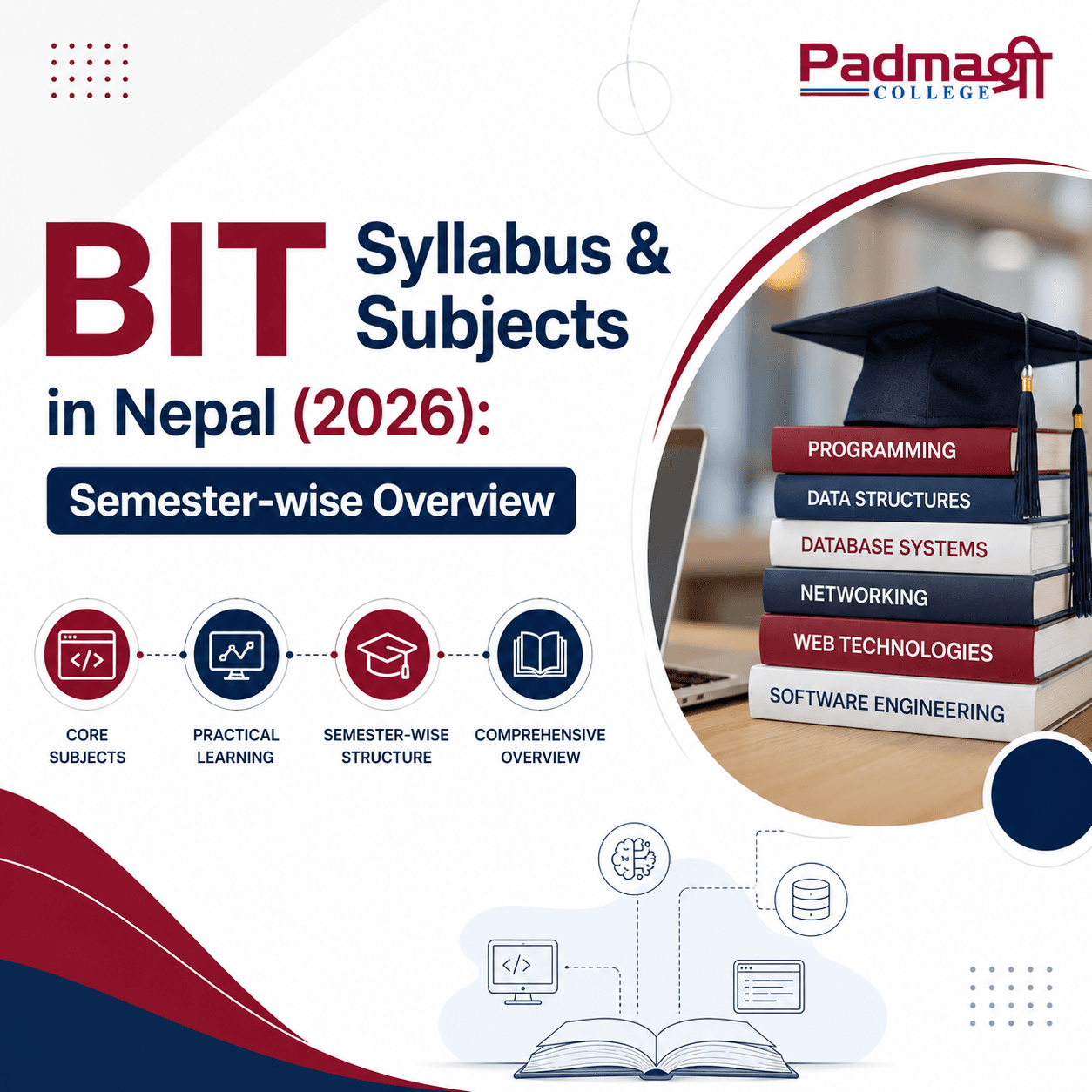
BIT Syllabus & Subjects in Nepal (2026): Semester-wise Overview
ADMISSIONS 2026

BIT Syllabus & Subjects in Nepal (2026): Semester-wise Overview

BIT Syllabus & Subjects in Nepal (2026): Semester-wise Overview If you're considering BIT, it helps to know what you'll actually study for four years. The Bachelor of Information Technology curriculum mixes hands-on IT with management, which is what gives the degree its range. Exact subjects vary…

Aug 16, 2026Read More
How to Become a Software Developer in Nepal (2026)
INTERNSHIP & PLACEMENT

How to Become a Software Developer in Nepal (2026)

How to Become a Software Developer in Nepal (2026) There's no single path to becoming a software developer in Nepal, and anyone who tells you there is hasn't hired one. What there is: a realistic sequence that works, whether you go the degree route or teach yourself. Here it is, without the…

Aug 16, 2026Read More