
Tinkune, Kathmandu01-4112252 • 9779851208403
Expert viewpoints, industry analyses, career roadmaps, and technological essays authored by Padmashree College professors, guest speakers, and student researchers.

<h1>From Medical Dreams to Tech Success: Your Options After MBBS Entrance</h1><p>The Medical Education Commission (MEC) published the MBBS entrance results on Wednesday, 18 November 2026 (Mangsir 2, 2083). The exam was held on 31 October. For a few thousand students, the result means counselling and a seat. For most of the rest, it means a hard week at home.</p><p>The numbers explain why. Around 22,000 students applied for the MBBS entrance this year, and last year MEC allocated 2,635 MBBS seats across the country. Even if the seat count moves a little this year, roughly eight out of nine applicants will not get an MBBS seat in Nepal this cycle. Missing the cut in a contest like that says more about the number of seats than about your ability.</p><p>If you are one of those students, this article is for you and for your parents. We will go through what the result means, your realistic options after MBBS entrance, and where a science background gives you a head start in technology and food science.</p><h2>First, read your result properly</h2><p>Log in to your MEC online profile and check your score and rank. MEC has said a separate notice on retotaling will be published later on its website. If you are close to the expected cut-off, wait for that notice and the counselling schedule before you give up on medicine.</p><p>Results for BDS, nursing, BPharm, BPH and other health science programs are published separately, sometimes on different dates. Check each one you applied for.</p><p>After that, you have three real options after MBBS entrance:</p><ul> <li>Prepare again for next year's MECEE-BL</li> <li>Take another health science program through MEC</li> <li>Move to a different field now</li> </ul><p>None of these is wrong. The mistake is drifting through a year without choosing one.</p><h2>Should you drop a year?</h2><p>Some students do improve a lot on a second attempt, usually the ones whose first score was already close. If medicine is the only career you want and you missed by a small margin, a gap year with a serious plan can make sense.</p><p>Be honest about the cost. A year of coaching fees, another year of pressure at home, and no guarantee at the end, because the number of MBBS seats barely grows year on year. If your score was far from the cut, or you sat the exam mainly because your family expected it, a second year often ends the same way.</p><p>Many students take a middle route. They start a bachelor's program now and decide before the next entrance whether they still want to sit it. A semester of university behind you costs nothing if you later switch.</p><h2>Why science students do well in IT</h2><p>You spent two years on biology, chemistry, physics and, for most of you, mathematics. You learned to study for long hours under exam pressure. That habit carries straight into a computing degree, where the first year is heavy on maths and programming practice.</p><p>Technology and health also overlap more than most people expect. Hospitals in Kathmandu run billing systems, lab software, patient records and telemedicine platforms, and someone has to build and maintain them. A graduate who understands what a lab report means and can also write the code behind it has a profile very few IT graduates can match.</p><h2>Your options after MBBS entrance at Padmashree College</h2><p>Padmashree International College has taught in Tinkune, Kathmandu since 2007. Three of our programs fit students coming from the medical entrance track particularly well.</p><h3>BIT (Nilai University, Malaysia)</h3><p>The four-year Bachelor of Information Technology is awarded by Nilai University and approved by Nepal's Ministry of Education. There is no entrance exam for BIT admission at Padmashree. If you have just finished months of MECEE preparation, that matters: you can start in the next intake without another entrance cycle. Ask admissions to confirm the minimum +2 grade for your stream. <a href="/course/bit">Read more about BIT at Padmashree</a>.</p><h3>BCA (Tribhuvan University)</h3><p>BCA is an eight-semester TU degree, and Padmashree has 35 seats. TU's BCA entrance is required, but it is a much lighter exam than MECEE. Choose BCA if you want a TU degree and don't mind one more test. <a href="/course/bca">Read more about BCA at Padmashree</a>.</p><h3>B.Tech in Food Technology (Tribhuvan University)</h3><p>For a biology and chemistry student, this is the closest field to medicine that is not medicine. Food technology covers microbiology, biochemistry, nutrition and food safety, applied to processing, quality control and public health. You need +2 Science with at least 50%. Graduates work in food and beverage companies, testing labs, and government bodies such as the Department of Food Technology and Quality Control. <a href="/course/btech-food">Read more about B.Tech Food at Padmashree</a>.</p><p>If you would rather leave science behind entirely, Padmashree also offers BBA and BA (Hons) Business and Hospitality Management, both through Nilai University.</p><h2>What parents usually ask us</h2><p>Parents who hoped for a doctor in the family tend to ask two questions. Is the degree recognised, and will it lead to a job?</p><p>On recognition: our Nilai University programs are approved by the Ministry of Education, and BCA and B.Tech Food are Tribhuvan University degrees. On jobs: no college can promise placement, and you should be careful with any that does. What we can do is show you the syllabus, introduce you to faculty and alumni, and let you judge for yourself. Bring your son or daughter to the campus and ask us the hard questions.</p><h2>What to do this week</h2><ul> <li>Check your result on your MEC profile and watch <a href="https://mec.gov.np" target="_blank" rel="noopener noreferrer nofollow">mec.gov.np</a> for the retotaling notice</li> <li>Decide honestly whether you would sit MECEE-BL again next year</li> <li>If IT or food science interests you, visit us at Raja Janak Marg, Tinkune, call <a href="tel:+97714112252">01-4112252</a>, or go to our <a href="/admission">admissions page</a> to ask about the next intake, fees and scholarships</li> </ul><p> </p><p>A missed MBBS seat closes one door. What you do in the next few weeks decides far more about your career than one entrance score.</p>
BIT Syllabus & Subjects in Nepal (2026): Semester-wise Overview If you're considering BIT, it helps to know what you'll actually study for four years. The Bachelor of Information Technology curriculum mixes hands-on IT with management, which is what gives the degree its range. Exact subjects vary…

How to Become a Software Developer in Nepal (2026) There's no single path to becoming a software developer in Nepal, and anyone who tells you there is hasn't hired one. What there is: a realistic sequence that works, whether you go the degree route or teach yourself. Here it is, without the…

IT Jobs in Nepal (2026): Career Paths, Scope & Salary IT is Nepal's fastest-growing export sector, and the job market reflects it. IT services exports are estimated in the hundreds of millions of dollars a year, and the companies driving that are hiring. If you're planning an IT career or choosing…

BCA vs BIT in Nepal (2026): Which Should You Choose? BCA and BIT are the two most accessible IT degrees in Nepal, both open to any +2 stream, and students mix them up constantly. The short difference: BCA is built around application and software development, while BIT goes wider into networks,…
BIT Scope in Nepal (2026): Career, Salary & Jobs BIT gets called the "silent winner" of Nepal's IT degrees, and the scope is the reason. A Bachelor of Information Technology graduate can move into software, systems, networks, or the IT side of a bank, and the degree is open to students from any +2…
BIT vs BSc CSIT in Nepal (2026): Entrance, Scope, Salary & Which to Choose You passed +2, you want a career in IT, and two names keep coming up: BIT and BSc CSIT. Every college gives you a different answer, usually the one that suits the college. This guide gives you the version that suits you,…
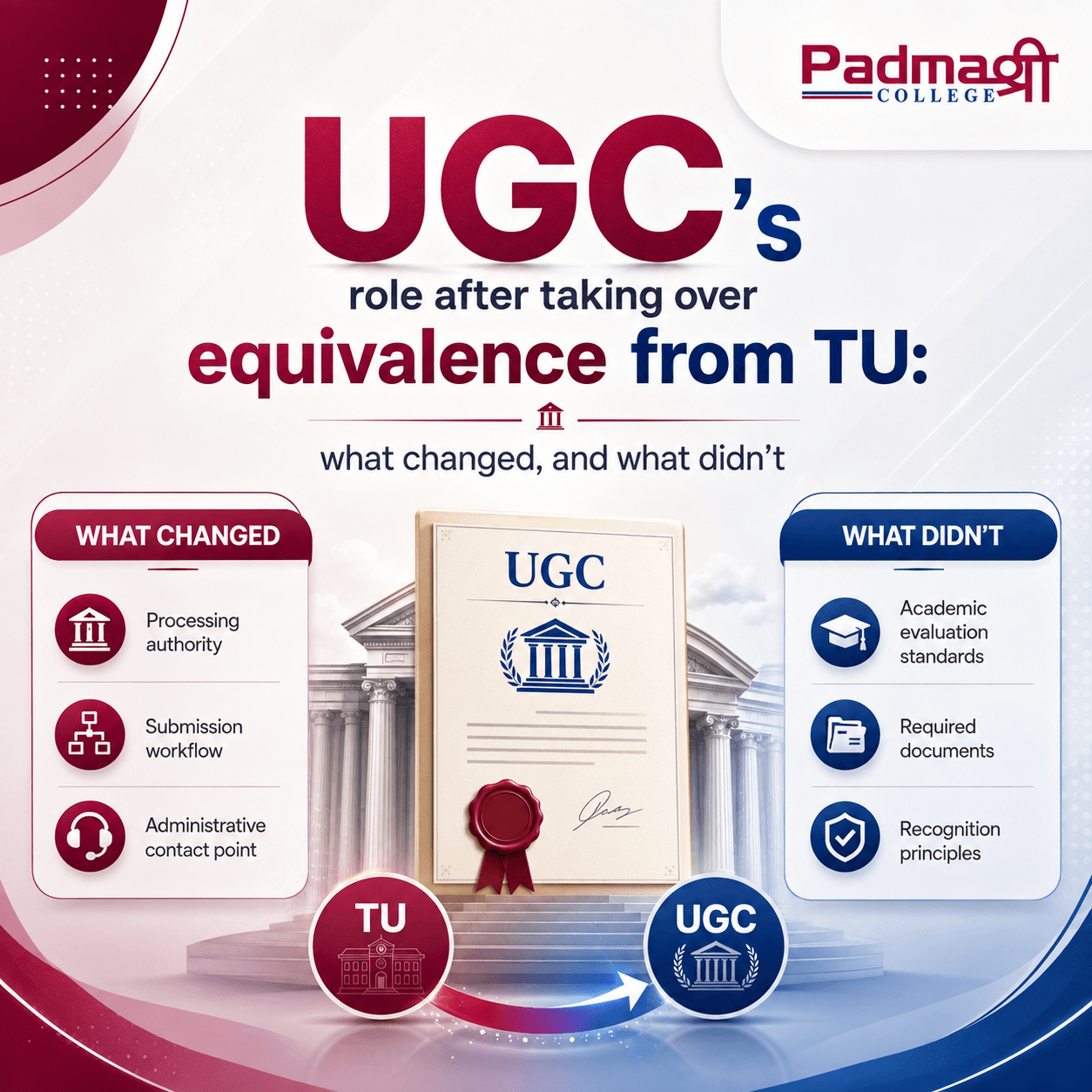
For nearly thirty years, if you earned a degree from a foreign university and wanted it recognised in Nepal, you went to one place: Tribhuvan University's Curriculum Development Centre. That door is now closed. As of Shrawan 1, 2083 (July 17, 2026), the University Grants Commission holds that…
What is the difference between BIT and BCA in Nepal? Padmashree International College, Tinkune, Kathmandu · Updated for 2026 admissions You cleared your +2 and you want a career in IT. Now two abbreviations keep showing up in every college brochure and every Facebook admission group: BIT and BCA.…

BIT in Nepal comes from three places: Tribhuvan University, Purbanchal University, or a Nepali college teaching a foreign university's IT degree under Ministry of Education approval. Which one you can realistically enter depends far less on which is "best" and far more on arithmetic. TU runs the…

BBA vs BBS in Nepal: Which One Should You Pick in 2026? The honest version of this comparison is short. BBS is cheap and flexible and you are largely on your own. BBA is expensive and structured and someone will notice if you stop attending. Almost everything else follows from that. The rest of…

There are roughly forty colleges in the Kathmandu Valley offering some version of an IT bachelor's degree, and most of them describe themselves as the best one. That is not information. It is noise, and it is the reason so many +2 graduates end up choosing on the basis of which counsellor was…