Padmashree International College
Tinkune, Kathmandu01-4112252 • 9779851208403
TECHNOLOGY & AI

Notice For B.Tech Food Entrance Form Open for 2081

Padmashree Academic Faculty
•
Sep 1, 2024
•
3 min read
Notice For B.Tech  Food Entrance Form Open for 2081

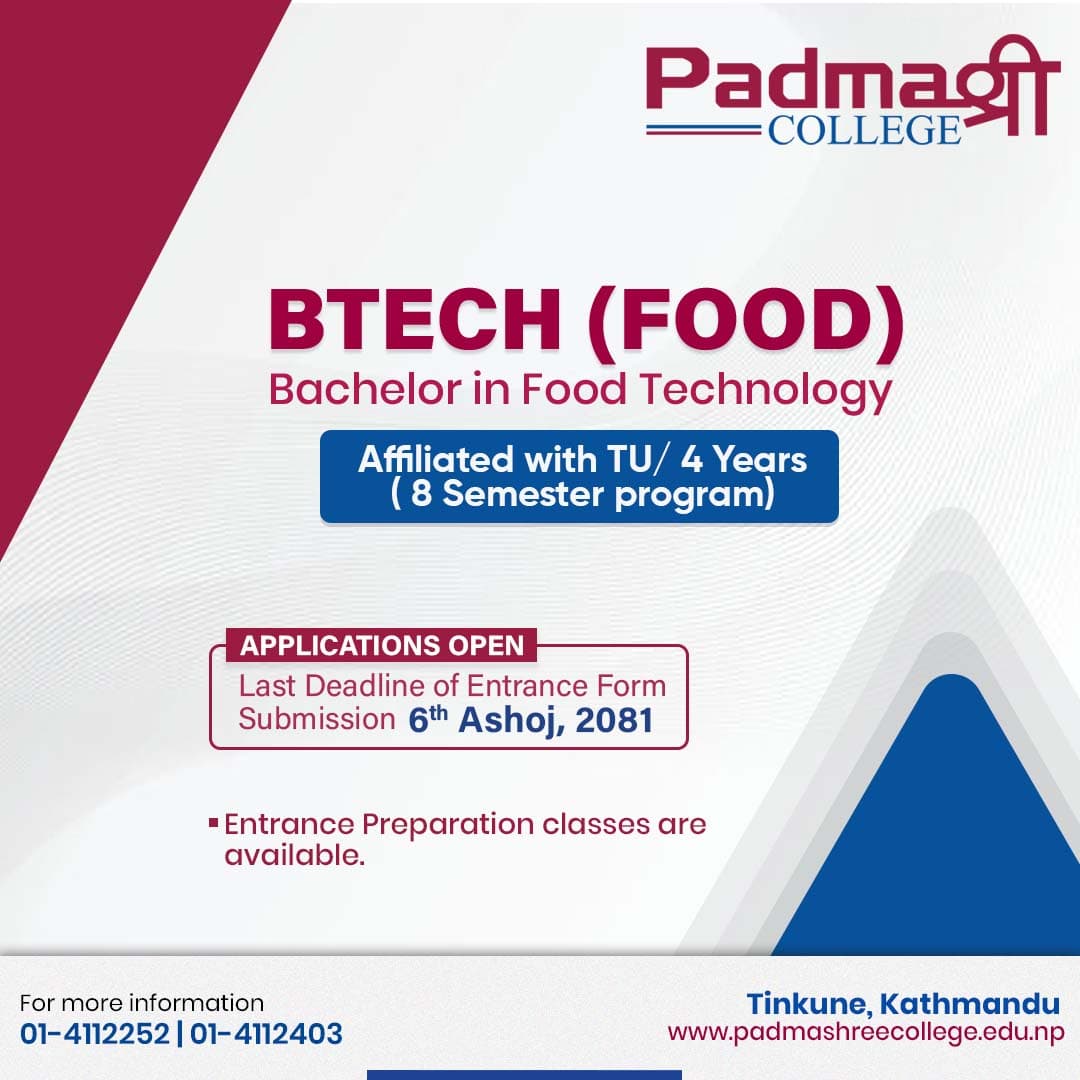
Tribhuvan University, Institute of Science and Technology (IOST) announces entrance exam date for four-year B.Tech Food Technology for 2081.

The admission process is completely online. Students have to submit the entrance application form online via the website of Tribhuvan University, Institute of Science and Technology. The application form opens from Bhadra 16, 2081, and will end on Ashoj 6, 2081.

B.Tech Food Entrance Dates and Information

  1. Online application form fee: Rs. 1650
  2. Online application form Opens From Bhadra 16, 2081.
  3. Last date to submit the Entrance Application form (with normal fee):  Ashoj 6, 2081
  4. Last date of form submission (with double fee):  2081 Ashoj 7 to 9. 
  5. Entrance Examination Date:  2081 Ashoj 13, 12 PM to 2 PM 
  6. Entrance centers will be published later.

Right now, Padmashree, one of the top colleges in Nepal offering BTech programs in food technology and affiliated with Tribhuvan University, is offering free entrance preparation classes, which are essential. Students who wish to enroll in the BTech Food Technology program must take and pass the entrance exam administered by TU, IOST.

View the official notice below.

Read the full course outline on the B.Tech Food Technology programme page, which lists the syllabus, entry requirements and how admission works.

Visit us in Tinkune, Kathmandu

We invite you to tour our modern classrooms, meet faculty members, and discover available scholarship options at our central Tinkune, Kathmandu campus.

Frequently Asked Questions

Padmashree College offers transparent, semester-based fee packages for BIT, BHM, BBA, BCA, and B.Tech Food. Tuition includes all practical laboratory access, university registration, and digital course resources. Flexible installment plans and scholarship reductions are applied automatically upon verification.
Tags:BBAMBABITTribhuvanNilaiAdmissions
PIC

Padmashree College Editorial Team

Academic research, curriculum design, and career guidance team specializing in IT, Hospitality, and Business education in Nepal.

Ready to Shape Your Future?

Padmashree College is now accepting applications for the 2025/2026 academic year in BIT, BHM, BBA, BCA, and B.Tech Food.

Discussion (1)

Have your thought about this? Leave a reply and start a discussion.

Comments are moderated in accordance with campus policy.
R

Rohan Shrestha

2 days ago

Very informative guide on BBA and BIT career opportunities in Kathmandu. Looking forward to attending the next open house session at Tinkune.

Table of Contents

4

Share this Post

Admissions Desk

Have questions about Nilai or TU eligibility? Schedule a counseling session at our Tinkune campus.

Inquire Online

Related Publications

Discover more articles, career guides & campus news.

Cyber Security Careers and Data Science in Nepal
CAREER GUIDE

Cyber Security Careers and Data Science in Nepal

<p>Two specialisations come up constantly when IT students in Nepal ask what to aim at after graduation: security and data. Both are real, both pay above the general development average, and both are routinely oversold by training providers.</p> <p>This is a practical look at cyber security careers and data science work in Nepal — who hires, what they actually test for, and how you get from a bachelor's degree to a role.</p> <h2>Who hires for security in Nepal</h2> <p>The employers are more concentrated than students expect. Banks and financial institutions are the largest source of security roles, driven by Nepal Rastra Bank's requirements around information systems. Beyond them: fintech and digital payment companies, telecoms, the larger outsourcing firms serving clients abroad, and a small number of specialist consultancies doing penetration testing and audit work.</p> <p>Government agencies hire too, though usually through regular service commissions rather than direct technical recruitment.</p> <h2>What security roles actually involve</h2> <p>Most entry-level work is not what students picture. It is security operations: monitoring alerts, investigating what triggered them, patching, access reviews, and compliance documentation. Penetration testing exists but is a smaller slice of the market and usually comes after a few years in operations.</p> <p>The split worth understanding before committing to one of these cyber security careers:</p> <ul> <li><strong>Security operations and incident response</strong> — the largest entry point, usually inside a bank or a managed service provider.</li> <li><strong>Penetration testing and vulnerability assessment</strong> — smaller, more competitive, strongly portfolio-driven.</li> <li><strong>Governance, risk and compliance</strong> — audit, policy and standards work. Less technical, steady demand in regulated industries.</li> <li><strong>Application security</strong> — reviewing code and build pipelines. Usually requires development experience first.</li> </ul> <h2>Who hires for data work</h2> <p>Data roles in Nepal split differently. True data science — building and deploying models — exists mainly in a handful of product companies and in firms serving overseas clients. Far more common, and far easier to get into, is data analysis and data engineering: building reports, maintaining pipelines, and making organisational data usable.</p> <p>Banks, telecoms, large retailers, development organisations and INGOs all employ analysts. The job title often says analyst rather than scientist, and the work is SQL, Python and dashboards rather than deep learning.</p> <p>Students who set out to be a data scientist and refuse analyst roles tend to stay unemployed longer than students who take the analyst job and move up.</p> <h2>What employers test</h2> <p>For both fields the honest answer is the same: evidence that you have done the thing. A certificate proves attendance. A portfolio proves capability.</p> <ul> <li><strong>For security:</strong> write-ups of machines you have worked through on practice platforms, a home laboratory you configured, a CTF record, or a disclosed finding handled responsibly. Networking fundamentals get tested in almost every interview.</li> <li><strong>For data:</strong> two or three projects where you obtained messy data, cleaned it, analysed it and explained the result in plain language. SQL is tested more often than machine learning.</li> </ul> <h2>Which degree gets you there</h2> <p>Neither field requires a specialised bachelor's in Nepal, and the specialised ones are thin on the ground. A solid general computing degree plus demonstrable independent work beats a narrow degree with nothing attached.</p> <p>What a degree should give you is networking, operating systems, databases, programming and enough mathematics to follow statistical reasoning. BIT, BCA and BSc CSIT all cover that. The TU BCA includes networking, network programming, cloud computing and cyber law; BIT at Padmashree runs 126 credit hours across eight semesters with laboratory work throughout and a credited internship.</p> <h2>A realistic first three years</h2> <p>Use the degree for fundamentals and build in parallel. In first and second year, get properly comfortable with Linux, networking and one programming language. In third year, pick a direction and start producing evidence — write-ups, projects, anything public. Use the internship deliberately rather than taking whichever placement is easiest.</p> <p>Graduates who do this have something to show at interview. Graduates who waited for the degree to deliver a career are competing on their transcript alone, and transcripts look similar.</p> <p>You can compare the computing routes on the <a href="/courses">programmes page</a>, or read our breakdown of <a href="/blogs/it-jobs-in-nepal-2026-career-paths-scope-salary">IT jobs and salary bands in Nepal</a> for the wider market.</p> <h2>Questions students ask</h2> <p><strong>Do I need certifications?</strong> Eventually, for some roles. Early on they matter less than people claim, and expensive certifications taken before you have practical experience are usually wasted money. Build the evidence first; let an employer fund the certification later, which many will.</p> <p><strong>Is there enough security work in Nepal to build a career?</strong> Yes, but it is concentrated in banking and finance, so be realistic about where you will likely work. Remote work for overseas clients has widened the market considerably in the last few years, and that is where a lot of the better-paid cyber security careers now sit.</p> <p><strong>Should I learn machine learning in first year?</strong> No. Learn to program properly, learn SQL, and learn enough statistics to know what a model is doing. Students who jump to machine learning before they can clean a dataset build things they cannot explain in an interview.</p> <p><strong>Can I move between the two fields later?</strong> Fairly easily, because the foundations overlap: both need programming, both need data handling, both need an understanding of systems. People move from analysis into security engineering and the other way round throughout their careers.</p>

Nov 25, 2026Read More
BCA vs BSc CSIT in Nepal: Which Should You Choose?
ADMISSIONS 2026

BCA vs BSc CSIT in Nepal: Which Should You Choose?

<p>Both are Tribhuvan University computing degrees. Both run four years across eight semesters. Both lead to software jobs. And every year a large number of students pick between them on the basis of which one sounds more serious, which is the wrong criterion.</p> <p>The real differences in BCA vs BSc CSIT are the entrance you have to clear, how much mathematics and physics you will do, and what the degree is built to produce. Here is how they actually compare.</p> <h2>The entrance is the first real difference</h2> <p>CSIT runs under the Institute of Science and Technology and uses the IOST entrance, which is heavily weighted towards physics, chemistry and mathematics. It is competitive, and in most years the number of candidates considerably exceeds the available seats at popular campuses.</p> <p>BCA runs under the Faculty of Humanities and Social Sciences and has its own entrance examination, separate from IOST. The eligibility is +2 in any stream with a minimum D+ in each subject. Students from Management and Humanities can sit it; for CSIT they generally cannot compete, because the paper assumes +2 Science.</p> <p>If you did not take +2 Science, this comparison is mostly settled for you already.</p> <h2>Mathematics and theory load</h2> <p>CSIT is the more theoretical degree. It carries more mathematics, more physics in the early semesters, and subjects like theory of computation and simulation that BCA does not include. If you intend to go into research, machine learning, or postgraduate study in computer science, that grounding is genuinely useful.</p> <p>The TU BCA syllabus carries five mathematics-leaning subjects across the whole degree: Mathematics I and II, Probability and Statistics, Numerical Methods, and Operations Research. The rest is applied — programming, databases, networking, web and mobile development, with three credited projects and a credited internship.</p> <h2>What each one is built to produce</h2> <p>CSIT is designed as a computer science degree. BCA is designed as a computer application degree, and the distinction is not marketing. BCA includes financial accounting, management, applied economics and MIS alongside the technical subjects, because the programme assumes graduates will work with computing inside organisations.</p> <p>In practice both produce software developers, and the Nepali job market does not meaningfully distinguish between them at entry level. Employers test what you can build.</p> <h2>Fees and duration</h2> <p>Both run four years. Both are TU degrees, so tuition at a given college is broadly comparable, and the difference between two colleges offering the same degree is usually larger than the difference between the two degrees at one college. Ask for the full fee including examination and laboratory charges, and ask what it was three years ago — that tells you how fast it rises.</p> <h2>Where graduates actually end up</h2> <p>Both degrees feed the same employers: software firms, banks, fintech, outsourcing companies and increasingly remote work for clients abroad. CSIT graduates are marginally more visible in roles involving algorithms and systems work. BCA graduates are common in application development, database administration, systems analysis and IT management.</p> <p>The strongest predictor of outcome for either degree is not the degree. It is whether you built things outside coursework, and whether your internship was real.</p> <h2>A straightforward way to decide</h2> <ul> <li><strong>You took +2 Science, enjoy mathematics, and might study further.</strong> CSIT, if you can clear the IOST entrance.</li> <li><strong>You took +2 Science but mathematics is a grind.</strong> BCA. You will cover the applied computing without the theoretical weight.</li> <li><strong>You took +2 Management or Humanities.</strong> BCA, or a foreign-affiliated BIT.</li> <li><strong>You missed the IOST cut-off.</strong> BCA has a separate entrance you can still sit this cycle.</li> <li><strong>You want to avoid a national entrance entirely.</strong> Neither. Look at a foreign-affiliated route instead.</li> </ul> <h2>Questions students ask</h2> <p><strong>Is BSc CSIT more respected than BCA?</strong> Among academics, somewhat. Among employers hiring junior developers in Nepal, not in any way that shows up in salary offers. Your portfolio decides that.</p> <p><strong>Can I do a master's after BCA?</strong> Yes. BCA graduates go on to MCA, MSc IT, MBA and postgraduate study abroad. If you are specifically aiming at an MSc in computer science at a research university, CSIT gives you a stronger theoretical base.</p> <p><strong>Which is harder?</strong> CSIT has the harder entrance and the heavier theory. BCA has a denser middle: semesters four, five and six run fifteen to seventeen credits with projects attached. Neither is easy, and both have significant dropout.</p> <p><strong>Can I apply for both?</strong> Yes, and many students do. The entrances are separate examinations with separate forms, so sitting both costs you two form fees and keeps a second route open.</p> <p>One last point on BCA vs BSc CSIT: you do not have to settle this alone in August. Both faculties publish their syllabuses, and sitting with the actual subject lists for an hour is more useful than any comparison article, including this one. Look at semesters three through six in each and ask yourself honestly which set you would rather study.</p> <p>If you want the subject-by-subject detail before deciding, read our breakdown of the <a href="/blogs/bca-syllabus-tu-semester-wise-subjects-and-credits">full TU BCA syllabus</a>, or the <a href="/course/bca">BCA programme page</a> for entry requirements and admission.</p>

Nov 25, 2026Read More
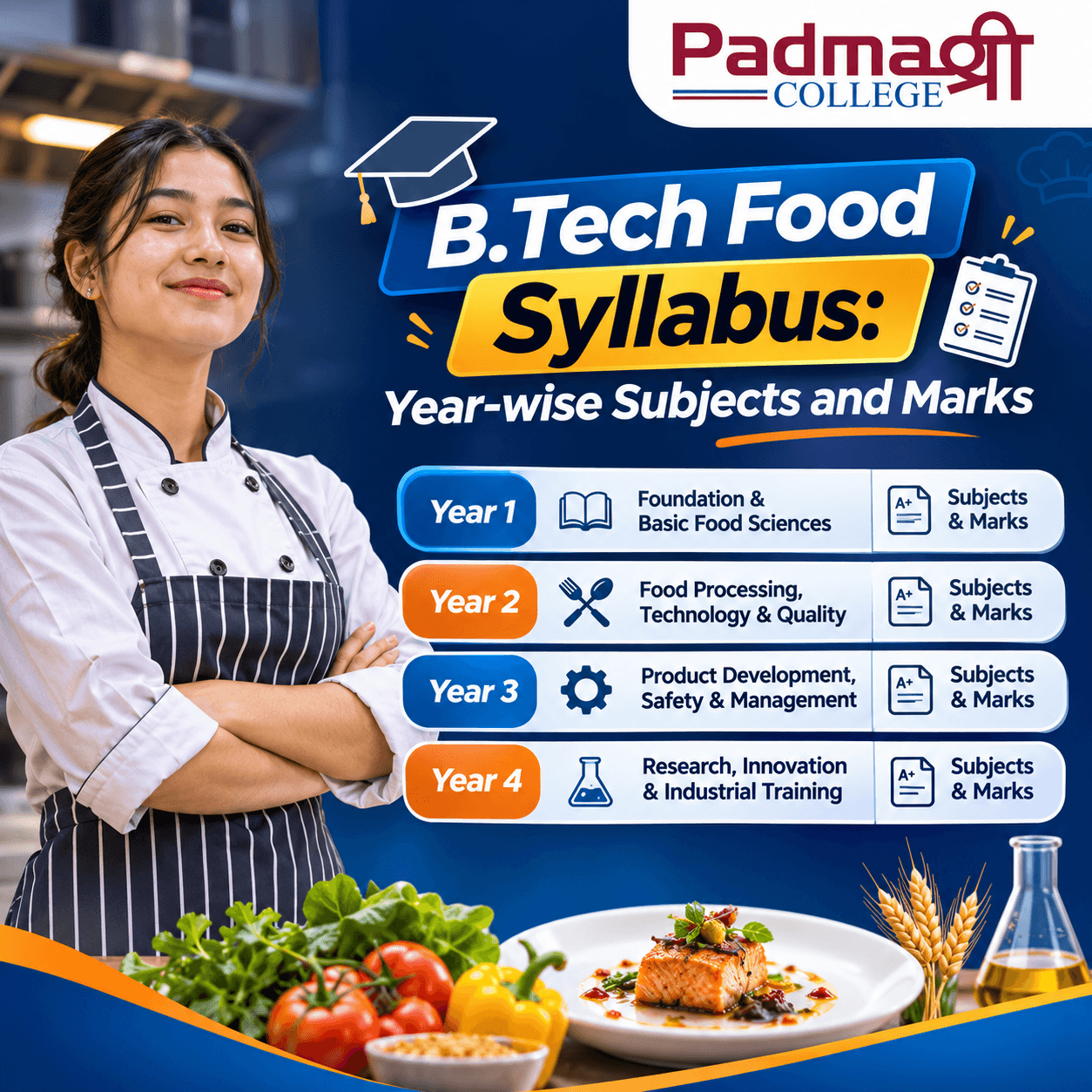
B.Tech Food Syllabus: Year-wise Subjects and Marks
INTERNSHIP & PLACEMENT

B.Tech Food Syllabus: Year-wise Subjects and Marks

<p>Tribhuvan University's B.Tech in Food Technology is unusual among Nepali bachelor's degrees in computing and science: it runs on the annual examination system rather than semesters, and it is marked out of 2,000 rather than counted in credit hours. If you are comparing it against a BCA or a BIT, that difference matters, because it changes how your year is structured and when the pressure falls.</p> <p>Here is the B.Tech food syllabus as TU sets it out, year by year, with the full marks attached to every subject.</p> <h2>How the marking works</h2> <p>The course totals 2,000 marks across four years. In every subject except the dissertation, 25% of the marks are allotted to practical work carried out in laboratories and pilot plants. That is a quarter of your degree earned on the bench rather than in an examination hall, which is higher than most science bachelor's programmes in Nepal.</p> <p>Because the system is annual rather than semester-based, you sit one major examination per year. There is no chance to recover a weak semester with a strong one; the year is the unit.</p> <h2>First year — 550 marks</h2> <p>Physics (100), Chemistry (100), Mathematics &amp; Statistics (100), Instrumental Technique of Analysis (100), Basic &amp; Food Microbiology (100), Basic Principles of Engineering (50).</p> <p>The first year is foundational science, and it is the reason the entrance requires +2 Science with Physics, Chemistry and either Mathematics or Biology. Students arriving without a solid chemistry background struggle, because food chemistry in second year builds directly on it.</p> <h2>Second year — 500 marks</h2> <p>Food Chemistry (100), Principles of Food Processing (100), Food Engineering covering unit operations and process engineering (100), Bio-Chemistry &amp; Human Nutrition (100, split 50 and 50), and TFP-I covering cereals, legumes, oilseeds and protein foods (100).</p> <p>This is where the degree becomes food technology rather than general science. Food engineering in particular is the subject that separates a food technologist from a food scientist: it is about moving, heating, drying and preserving material at industrial scale.</p> <h2>Third year — 500 marks</h2> <p>TFP-II covering fruits, vegetables, chocolate and sugar confectionery, tea, coffee and spices (100), TFP-III covering meat, fish and poultry (100), Biochemical Engineering (100), Industrial Microbiology (100), and Food Quality Control &amp; Analysis (100).</p> <p>Third year is the product-category year. The TFP sequence works through the major commodity groups, each with its own processing, spoilage and preservation problems. Food Quality Control &amp; Analysis is the subject most directly tied to employment, because quality assurance is where most graduates start.</p> <h2>Fourth year — 450 marks</h2> <p>Storage &amp; Packaging Technology (100, split 50 and 50), Operations Research &amp; Food Plant Management (100), Dairy Technology (100), Dissertation (100), and In-Plant Training with class seminar (50).</p> <p>The final year carries the lowest mark total but the heaviest independent workload. The dissertation is the only component with no practical percentage attached, and the in-plant training is your first extended exposure to a working facility.</p> <h2>What this prepares you for</h2> <p>The structure maps closely onto how the industry actually hires. Quality assurance and production roles want the third-year quality control and processing subjects. Dairy processing is a significant employer in Nepal and gets a full subject in fourth year. Research positions and postgraduate study lean on the dissertation.</p> <h2>Choosing where to study it</h2> <p>Because 25% of nearly every subject is practical, the single most important thing to check is the laboratory and pilot plant. A college teaching this B.Tech food syllabus without working pilot-plant equipment is teaching a quarter of the degree on paper.</p> <p>Ask to see the processing laboratory, the microbiology laboratory, and whatever pilot-scale equipment the college has. Ask how many students share it in a practical session. Then ask where last year's in-plant training placements were.</p> <p>The <a href="/course/btech-food">B.Tech Food Technology programme page</a> lists the entry requirements and admission route, and our post on the <a href="/blogs/btech-food-technology-entrance-2083-tu-iost-form-is-now-open">TU IOST entrance form</a> covers the examination you sit first.</p> <h2>Questions about the B.Tech food syllabus</h2> <p><strong>Why marks instead of credit hours?</strong> Because the programme runs on TU's annual examination system rather than a semester system. The two are not directly comparable, so converting 2,000 marks into a credit figure is misleading. When a college quotes credit hours for this degree, it is describing a different programme.</p> <p><strong>Can I join from +2 Management or Humanities?</strong> No. The entrance requires +2 Science with Physics, Chemistry and either Mathematics or Biology, at a minimum grade C or second division, plus a pass in the TU IOST entrance examination. The first-year science load is the reason.</p> <p><strong>How hard is the IOST entrance for food technology?</strong> Competitive, but far less so than for engineering or CSIT, because fewer candidates sit it. That makes it one of the more realistic TU science routes for a student with a solid +2 Science result.</p> <p><strong>What do graduates actually do?</strong> Quality assurance and production roles in food manufacturing, dairy processing, and food safety and regulatory work, in both government and private sectors. Some go into research or teaching, and the dissertation year is what prepares you for that.</p> <p><strong>Is the annual system harder than semesters?</strong> It concentrates risk. One examination decides the year, so a bad few weeks costs more than it would under a semester system. Students who work steadily through the year do well; students who rely on cramming before examinations find the volume unmanageable.</p> <p><strong>Does the 25% practical weighting apply to the dissertation?</strong> No. The dissertation is the single exception, marked out of 100 on the submitted work.</p>

Nov 25, 2026Read More