UGC's role after taking over equivalence from TU: what changed, and what didn't
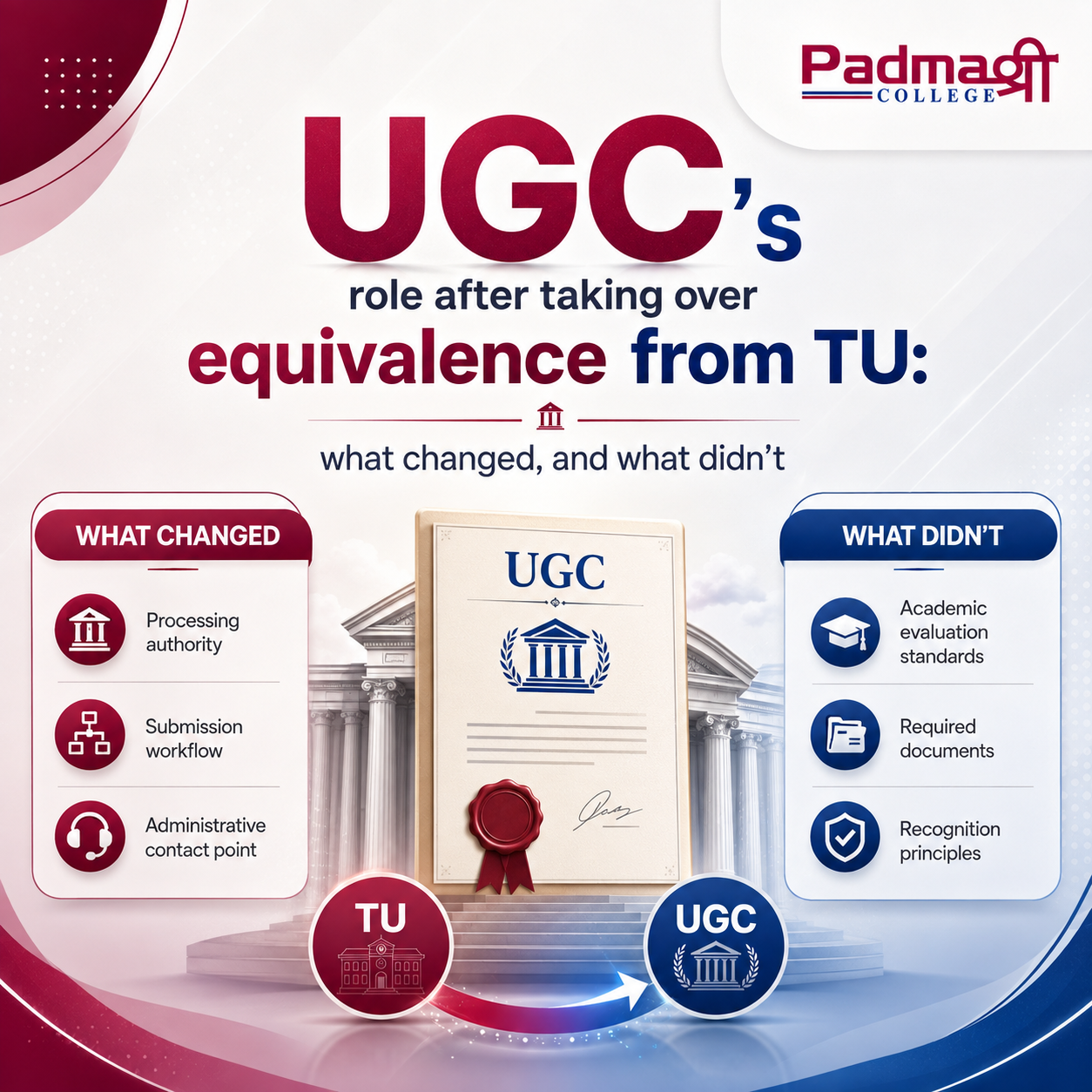

For nearly thirty years, if you earned a degree from a foreign university and wanted it recognised in Nepal, you went to one place: Tribhuvan University's Curriculum Development Centre. That door is now closed. As of Shrawan 1, 2083 (July 17, 2026), the University Grants Commission holds that authority.
If you studied abroad or finished a foreign-affiliated program in Nepal, the question on your mind is simple: did the rules change, or just the office? The honest answer is mostly the second one. The equivalence requirement, the documents, and the process are the same. What moved is who signs the certificate.
Per the University Grants Commission notice dated 2083/04/02, all equivalence-related work runs through UGC instead of TU from 2083/04/06, that is Shrawan 6, 2083 (around July 21, 2026). The legal authority itself transferred a few days earlier, on Shrawan 1, when TU's Curriculum Development Centre stopped accepting new equivalence applications.
This is not an internal reshuffle. It comes from Parliament amending Section 6 of the University Grants Commission Act, 2050, through the Some Nepal Acts Amendment Act, 2082. The same amendment gave UGC clear legal authority over two things it had handled informally before: credit transfer between universities, and Quality Assurance and Accreditation.
UGC is now the single national authority that decides whether a degree earned abroad, or through a foreign university's program run in Nepal, matches a Nepali qualification. That certificate is what you need for a government job, a professional licensing exam, a scholarship, or admission to a Nepali master's program.
Alongside equivalence, UGC now formally owns credit transfer and QAA. So the body checking whether your foreign college is properly accredited is now the same body issuing your equivalence. That consolidation is the real point of the reform.
This is the part worth being clear about, because rumour travels faster than fact.
The requirement is the same. If you needed equivalence before, you still need it. If you did not, you still do not. The documents are the same: academic transcripts, certificates, and verification of the awarding institution. Old TU certificates stay valid, so if TU already equivalated your degree, you do not reapply to UGC and there is nothing to redo. The purpose is the same too: further study, government service, licensing, and employment.
Only the issuing office moved from TU to UGC. That is the whole of the change, and anxious students deserve to hear it said plainly.
Anyone holding a degree from a university outside Nepal. That covers two groups people often confuse. First, students who physically studied abroad and returned. Second, students who studied at a college in Nepal that awards a foreign university's degree, because that degree is still a foreign qualification and needs equivalence the same way.
Health-science graduates feel this most sharply. Returning doctors, physiotherapists, and optometrists need equivalence to sit licensing exams, and the timing of the handover has landed right on top of their exam schedules.
Applications are online through UGC's dedicated portal at ugcequivalence.edu.np. You create an account, upload documents, pay the fee, and receive the certificate without visiting the office in most cases. For queries, UGC sits at Sanothimi, Bhaktapur, reachable on 01-6638548, 6638549, or 6638550, and at ugc@ugcnepal.edu.np.
There is one shift beyond "same process, new office." Until now, even graduates of other Nepali universities had to get equivalence from TU for government service. UGC has signalled it will end that discrimination among domestic universities. If you hold a Pokhara University or Purbanchal University degree, watch this space.
Who gives foreign degree equivalence in Nepal now? UGC. TU's Curriculum Development Centre stopped this work from Shrawan 1, 2083 (July 17, 2026).
I already have a TU equivalence certificate. Is it still valid? Yes. It stays valid and you do not reapply.
Did the process or documents change? No. Only the issuing office changed from TU to UGC. The requirement, documents, and purpose are the same.
Where do I apply? Online at ugcequivalence.edu.np, effective from Shrawan 6, 2083.
Does this apply to foreign-affiliated colleges in Nepal? Yes. A degree awarded by a foreign university, even when studied in Nepal, needs UGC equivalence.
--semester-wise-overview.png)
BIT Syllabus & Subjects in Nepal (2026): Semester-wise Overview
BIT Syllabus & Subjects in Nepal (2026): Semes ....png)